Sunday, May 21, 2017

Last day of Sunday School

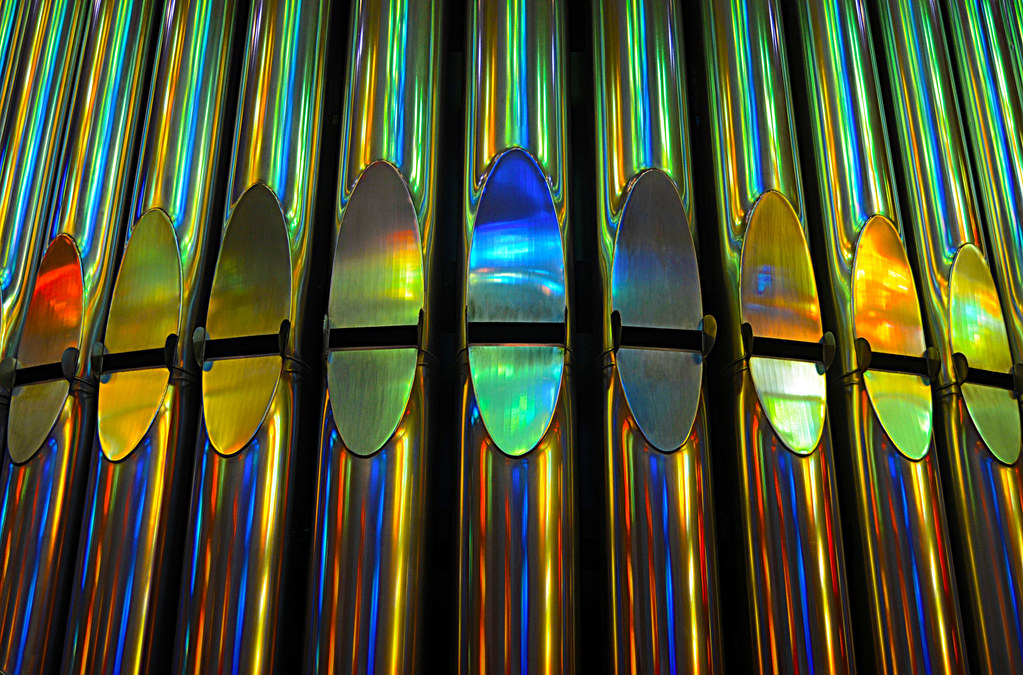
To celebrate the last day of Sunday School for the year, the children were treated to a demonstration of our pipe organ. Not only did they get to see the inner workings of the instrument, they also made their own music by blowing into some organ pipes!


They also sang some of their songs during the 11:00 service.


Wednesday, April 19, 2017

Bird's eye

(click to enlarge)

Few in the congregation ever get to see the sanctuary from this perspective: looking out from the upper level of the organ chamber. Look closely and you may spot our evening custodian diligently running the vacuum down below.

The sanctuary was designed to hold 700 people when it was constructed in 1874, although it seats about 450 in its current configuration. (Originally the aisles were narrower, and there were more rows of pews -- extending forward roughly to where the pulpit and lectern are now.)

Thursday, April 6, 2017

Holy Week at First Presbyterian

Holy Week
at the First Presbyterian Church of Meadville


Maundy Thursday
Service of Holy Communion
April 13, 7:30 PM
 
Good Friday
Service of Tenebrae
April 14, 12:00 noon
in the Chapel
 
Easter Sunday
A Celebration of the Resurrection
April 16, 9:00 & 11:00 AM
with the French Creek Brass Quintet at both services

Monday, April 3, 2017

Beethoven, Wesley, and the Test of Time

(This article was originally published in the April 2017 edition of the church newsletter.)

This past month I accepted an invitation from Chris and Charlotte Thomas to join them for an Erie Philharmonic concert.   Every one of the Warner Theatre’s 2,250 seats was filled to hear pianist Emanuel Ax and the orchestra give a stirring performance of Ludwig van Beethoven’s Piano Concerto #5, composed way back in 1809.  On the drive home I found myself ruminating about why some art endures for centuries, while much of it is quickly forgotten.  After all, Beethoven was merely one of hundreds of composers at work in the year 1809.  Vincenzo Righini, Josef Eybler, Louis Spohr...do these names ring a bell?  Of course not.  Their music was just as well-liked by the public, and perhaps just as tuneful, but somehow lacking the spark of genius, the mastery of form and structure that Beethoven wielded.

We often refer to this phenomenon as the test of time.  It's the notion that if something has enough artistic merit, or a profound insight to offer, it becomes absorbed into our collective cultural heritage and passed down for future generations to study and enjoy.  In this category we would surely place not only the music of Beethoven but also the paintings of Da Vinci and Picasso, the poetry of Dante and Shakespeare, and the architecture of Christopher Wren and Frank Lloyd Wright, to name a few.  Their works endure because they go far beyond just tickling the eyes and ears.

If you’re wondering where I’m headed with this: my point is that the same is true of the church’s sacred arts as well.  I’ll offer just one example of many.  Charles Wesley, the brother of Methodism’s founder John Wesley, wrote over 6,000 hymns in the 18th century.  Our hymnal contains a dozen of these, such as Come, Thou Long-Expected Jesus and O For a Thousand Tongues to Sing.  Classic hymns, to be sure, but why only a dozen?  I've looked at some of the others, and frankly, to call them 'mediocre' would be putting it charitably.  In the zeal of his faith Charles Wesley wrote a lot of junk which, mercifully, the test of time has purged. (By contrast, almost all of Beethoven’s music is still performed today, which I consider a testament to his genius.)

The same process is still happening now, on a timescale slow enough that we may not perceive it.  People are writing new songs for the church at a furious pace — and I don’t just mean the bass-guitar-and-drum driven "Praise & Worship" style, but also new music in more traditional idioms, such as my own compositions.  And like the hymns of Charles Wesley, a few of these may endure as part of Christianity’s cultural legacy.  But most will end up in history’s wastebasket.  That's not to say that people shouldn’t be offering new songs to the Lord: Psalm 149 actually encourages it!  But in reality, combining theological soundness with artistic appeal is a difficult task, and we should be on guard against songs that sacrifice one for the other.  (There’s much more to say on that topic, but I’m afraid I’m out of space right now!)

Until next time,
Kevin

Thursday, March 9, 2017

A Little Evening Music


A Little Evening Music

Sonya Eagles-Dill soprano
John Knobel baritone
Juanita Shutsa flute
Kevin Dill piano

Friday, March 31, 2017
7:00 PM
First Presbyterian Church, 890 Liberty St, Meadville

Program to include:
Duvernoy Fantasia on 'Au Clair De La Lune'
Barber Four Songs, Op. 13
Grieg Lyric Pieces, Op. 43 (selections)
Purcell Evening Hymn
Schumann Romance, Op. 94 No. 1
Hüe Nocturne

Admission is free, but please consider bringing a 16-ounce jar of peanut butter to support Meadville's WiNS (Weekend Nutrition for Students) program.

Monday, February 6, 2017

Musings of an Organ Teacher

(This article was originally published in the February 2017 edition of the church newsletter.)

As some of you know, I've been the organ instructor at Allegheny College for the past few semesters, following in the footsteps of a dear woman named Rebecca Borthwick-Aiken.  My students aren't music majors who are already proficient organists: those kids opt for conservatories like Juilliard or big-city colleges like Duquesne.  Instead, I end up with science and humanities students who have some piano lessons under their belt and want to try the organ mainly out of curiosity.  Guiding them through their first introduction to the organ has proven surprisingly rewarding.  At the same time, though, it highlights how many people (even some fairly sophisticated musicians) underestimate the difference between the organ and the piano.
 
But wait — they both have keys, so aren't they basically the same?  In short, no!  I won’t bore you with technical details here, but physically and musically speaking, the two instruments must be approached entirely differently. Seating an excellent pianist at an organ console unprepared is going to result in a lot of clunky, awkward playing, since the organ lacks the 'sustain' pedal which smoothes out the piano's sound.  (To connect notes and chords together, organists dip into a bag of techniques that pianists seldom bother with.)  In fairness, I should note that the reverse is also true: trained organists pounding on the piano can make some very un-musical music.  I'm occasionally guilty of this myself!
 
There’s also the matter of registration: the art of knowing which sounds to choose for a particular piece of music.  Before my students can even start to make those decisions for themselves, they must learn the names of all the fancy knobs and tabs on the organ console and what each of them does.  This alone can take months to get a feel for.  By contrast, the piano undeniably makes up for in simplicity what it lacks in variety.

And we haven’t even mentioned the pedals, the aspect of organ playing my beginning students find the most unnatural.  I tell them it’s not unlike learning to ride a bicycle.  It may be confusing, awkward, and frustrating at first…but if you keep trying, something eventually just ‘clicks’ and you’re off to the races!  After a few lessons they can play some notes without looking, and by semester's end their pedal scales are reasonably smooth.  The final step is adding pedal notes while the hands are busy doing something else; that level of coordination is the work of at least one lifetime!
 
Until next time,
Kevin

Friday, December 16, 2016

Christmas Organ Recital


Kevin Dill, organist
on the 2500 pipe Schlicker organ
with guest soprano Sonya Eagles-Dill

Tuesday, December 20, 2016
11:45 AM
First Presbyterian Church, 890 Liberty St, Meadville

Handel Overture to the Occasional Oratorio
Vaughan Williams Sweet Was the Song, from Hodie
Wackenthaler L'Adoration des Bergers
Traditional, arr. Dill Mitt Hjerte Alltid Vanker
Bedford A Christmas Suite

This recital is presented as part of First Presbyterian's 'Lunch @ First' series, which offers programs on a variety of topics on the third Thursday of each month. Admission to the recital is free, with a $5 lunch available afterwards.